Power outages can interrupt heating, refrigeration, lighting, internet access, sump pumps, and other systems your household relies on. For homeowners in Burlington, VT, a whole house generator provides a practical way to keep essential electrical systems running without hauling out a portable generator or manually connecting equipment.
Hood Electric provides whole house generator installation and electrical services for homeowners throughout Burlington and surrounding Vermont communities. Owner and Master Electrician Nick Hood works directly with each client, from discussing the electrical requirements to completing the installation. If you are considering standby power for your home, here is what you should know before getting started.
In this article:
–Automatic backup power: A whole house generator can keep essential systems running during outages in Burlington, VT.
–Proper sizing matters: Your generator should match your home’s electrical demand and the circuits you want to power.
–Professional installation is key: Hood Electric installs generators, transfer switches, and related electrical upgrades for Burlington-area homes.
We at Hood Electric specialize in electrical panel upgrades, generator installation, and electrical repairs and troubleshooting in Burlington, VT and surrounding communities. Owner and Master Electrician Nick Hood works directly with homeowners, builders, and contractors to provide dependable electrical work, clear communication, and practical solutions for each property. From upgrades and renovations to backup power and repairs, we focus on work that supports your home for years to come. Contact Hood Electric to discuss your electrical project.
Whole House Generator Installation in Burlington, VT
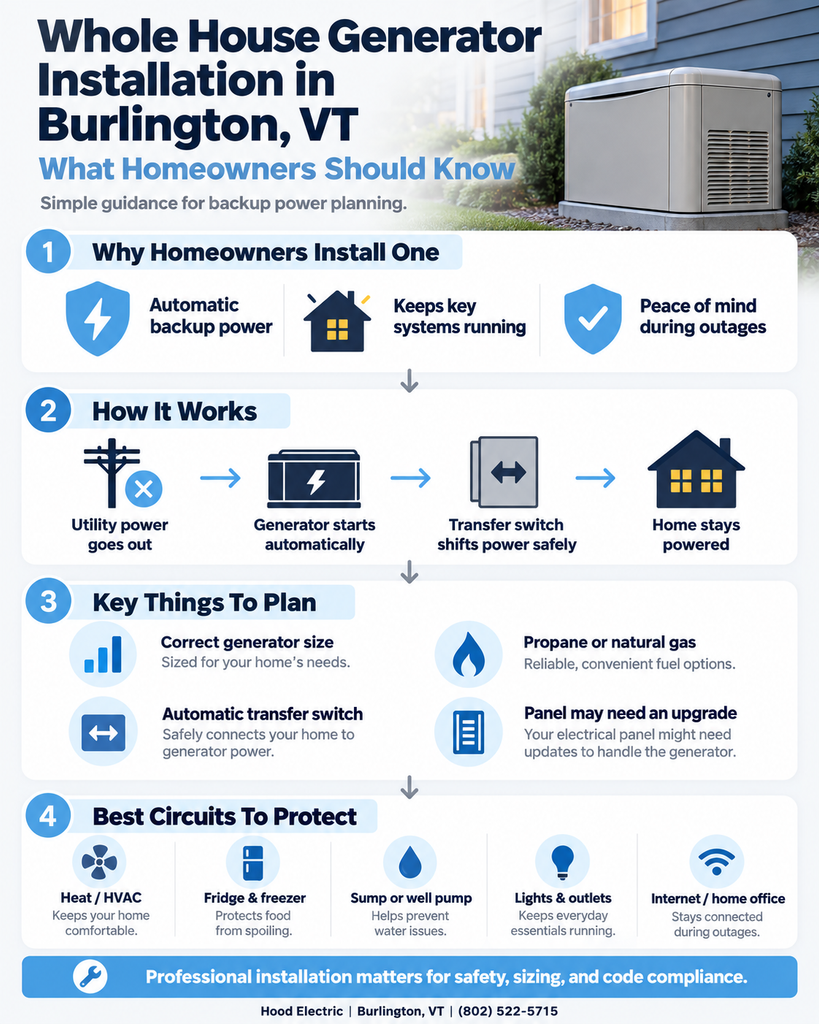
A whole house generator, also called a standby generator, connects permanently to your home’s electrical system. Unlike a portable generator that needs to be moved, fueled, and connected during an outage, a properly installed standby system can restore power automatically.
The generator typically sits outside the home and runs on propane or natural gas. It works alongside an automatic transfer switch that detects an interruption in utility power.
When utility power goes out, the system starts the generator and transfers the home’s electrical load. Once utility power returns, the transfer switch moves the home back to normal service and the generator shuts down.
For Burlington homeowners who want dependable backup power, this automatic operation is one of the main reasons to install a permanent system.
Choosing the Right Whole House Generator
Generator size matters. Installing a unit that is too small can leave you without enough capacity for the equipment you want to operate. An unnecessarily large generator can add expense without providing much additional value.
Before recommending a generator, an electrician should look at your home’s electrical demand and determine what you want powered during an outage.
Common priorities include:
- Heating equipment and essential HVAC systems
- Refrigerators and freezers
- Well or sump pumps
- Kitchen circuits
- Lighting and outlets
- Internet and home office equipment
- Select appliances and other important household systems
Some homeowners want backup power for essential circuits, while others want a system capable of supporting most or all of the house. Hood Electric can evaluate your electrical setup and help determine an appropriate generator capacity.
Why an Automatic Transfer Switch Matters
The transfer switch is a critical part of a standby generator system. Its job is to safely change the home’s power source between the electrical utility and generator.
An automatic transfer switch makes the process much simpler for the homeowner. You do not have to be home to start the generator when an outage occurs.
That can be particularly useful during Vermont winters or when you are traveling. Your home can maintain power to the circuits connected to the backup system even when nobody is there to operate equipment manually.
Proper transfer switch installation is also important for electrical safety. A generator should never send electricity back toward utility lines. Your electrician installs the generator and transfer equipment so the two power sources remain properly separated.
Does Your Electrical Panel Need an Upgrade?
Generator installation is also a good time to look at the condition and capacity of your electrical system.
Older Burlington-area homes may have panels or wiring that no longer match the household’s current electrical demand. Home additions, electric heating, larger appliances, EV charging, and other improvements can increase the amount of electricity a property uses.
A panel may also need attention because of age, corrosion, damage, or limited capacity.
When it comes to whole house generator installation, evaluating the existing panel helps determine how the generator and transfer equipment should integrate with your home.
Hood Electric handles electrical panel upgrades, service upgrades, electrical repair, and rewiring in addition to generator work. Having one electrician evaluate the complete system can make it easier to address related electrical needs at the same time.
Whole House Generator Fuel Options
Most residential standby generators use propane or natural gas. The right option depends partly on what is available at your property.
Natural gas can provide a continuous fuel source where service is available. Propane offers another practical option, particularly for Vermont properties that already have a propane tank serving heating equipment or appliances.
Generator selection should account for more than fuel type. The home’s electrical demand, available installation space, generator specifications, transfer switch, and existing electrical service all need to work together.
A local electrician can help sort through these details before equipment is purchased and installed.
Generator Installation for New Homes and Renovations
Planning a generator during new construction or a substantial renovation can simplify the electrical work. Builders, contractors, and homeowners can account for the generator, transfer switch, panel capacity, and related wiring while planning the rest of the electrical system.
Hood Electric works with home builders and smaller contracting crews on new homes, additions, renovations, and electrical system upgrades.
For custom homes, backup power can become part of the electrical plan from the beginning rather than an addition made years later. This allows the generator system to fit naturally into the home’s overall power requirements.
Local Electrician Serving Burlington and Nearby Vermont Communities
Hiring a local electrician means working with someone familiar with residential electrical needs in the area. Hood Electric is owned and operated by Nick Hood, a Vermont Master Electrician who started the company after working for other electrical contractors and deciding he wanted to provide clients with more direct communication and consistent workmanship.
There is no large chain of people between the homeowner and the electrician doing the work. Nick communicates with the client and performs the electrical work himself — keeping questions, project details, and decisions straightforward.
Hood Electric serves homeowners, builders, and contractors in Burlington, Colchester, Stowe, Richmond, Hinesburg, and Ferrisburgh, VT.
Electrical Company for Generator Installation and Home Upgrades
A generator is an investment in how your home functions when utility power is unavailable. Proper planning helps ensure the generator has enough capacity, the transfer switch operates correctly, and the equipment integrates safely with your existing electrical system.
Hood Electric provides generator installation, whole house generator systems, transfer switch installation, electrical repair, panel and service upgrades, rewiring, three way switch wiring, and other residential electrical services.
If you are considering a whole house generator for your Burlington home, call Hood Electric at (802) 522-5715 to discuss your property and backup power needs. You can also visit Hood Electric to learn more about local electrical services.
Other articles to check out: